

The hospitality industry has always been known for long hours, fast-paced environments, and high turnover — but new data shows the problem may be growing even bigger in 2026.
According to a recent analysis by OysterLink using data from the U.S. Bureau of Labor Statistics (BLS), hospitality workers are quitting their jobs at a higher rate than employees in any other industry across the country.
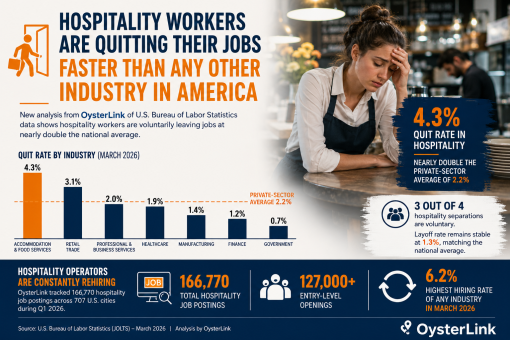
In March 2026, the quit rate for accommodation and food service workers climbed to 4.3%, nearly double the private-sector average of 2.2%. That means more workers in restaurants, hotels, bars, and other hospitality businesses are voluntarily walking away from their jobs than in any other field.
Hospitality Workers Are Choosing to Leave
What makes this trend especially interesting is that most of these departures are not due to layoffs or company cuts.
The report found that roughly three-quarters of hospitality separations are voluntary, meaning employees are choosing to leave on their own. Layoff rates in the industry remain stable at 1.3%, matching the national average.
In other words, hospitality businesses aren’t necessarily firing workers — workers are simply deciding they no longer want to stay.
For many employees, the reasons may not come as a surprise:
- Long and unpredictable hours
- Physically demanding work
- Limited work-life balance
- Burnout from customer-facing roles
- Difficulty earning a livable wage in some positions
Over the last few years, many workers have started reevaluating what they want from their careers, and the hospitality industry appears to be feeling that shift more than most.
No Other Industry Comes Close
While turnover happens in every field, hospitality stands far above the rest.
Here’s how other industries compare:
- Retail trade: 3.1% quit rate
- Professional and business services: 2.0%
- Healthcare: 1.9%
- Manufacturing: 1.4%
- Finance: 1.2%
- Government: 0.7%
The gap between hospitality and the rest of the workforce is significant, highlighting just how difficult it has become for restaurants, hotels, and food service businesses to retain employees.
Businesses Are Constantly Hiring
The hiring numbers tell another side of the story.
OysterLink tracked more than 166,000 hospitality job postings across 707 U.S. cities during the first quarter of 2026. More than 127,000 of those openings were entry-level positions.
Many of these job listings are believed to be replacement hires rather than newly created jobs. Businesses are continuously searching for workers simply to fill positions left vacant by employees who quit.
The hospitality industry also posted the highest hiring rate among all industries at 6.2% in March 2026 — another sign of the revolving door many businesses are facing.
What This Means for the Industry
For hospitality operators, constant turnover creates ongoing challenges:
- Increased hiring and training costs
- Staff shortages during busy seasons
- Lower employee morale
- Reduced consistency in customer service
For workers, however, the high quit rate may signal growing confidence in seeking better opportunities, more flexibility, or improved working conditions elsewhere.
As labor shortages continue and businesses compete for reliable employees, hospitality companies may need to rethink wages, scheduling, benefits, and workplace culture if they hope to retain talent long-term.
One thing is clear: in 2026, hospitality workers are no longer afraid to walk away from jobs that no longer work for them.